Hong Kong cements its place as an essential engine of China’s trade growth
- Nov 10, 2025
- 3 min read
10 November 2025
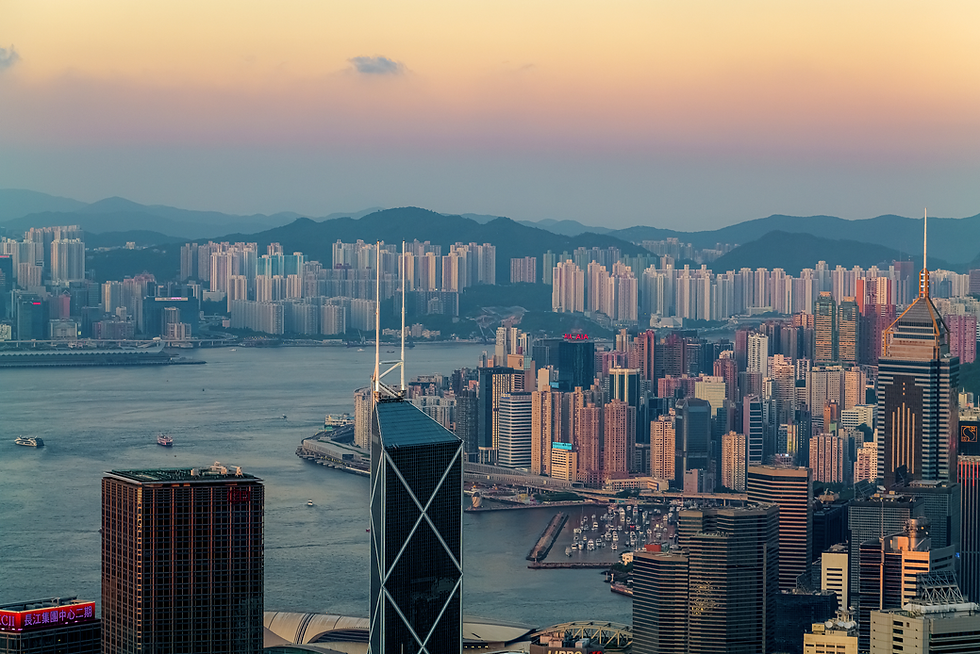
In the first three quarters of 2025, China’s mainland registered a 4 percent increase in goods trade compared to the same period last year, with growth accelerating each quarter 1.3 percent in Q1, 4.5 percent in Q2 and 6 percent in Q3.
At the centre of this uptick is Hong Kong, whose trade with the mainland reached a record $261.56 billion over that span. Imports from Hong Kong surged by 86.6 percent year-on-year, surpassing rises in previous quarters as well as last year’s full-year results of 12.4 percent and 35.8 percent. Meanwhile, mainland exports to Hong Kong climbed by 12.6 percent above last year’s Q3 and annual benchmarks of 9.8 percent and 6.2 percent.
Analysts describe Hong Kong as an “accelerator” in China’s import ecosystem, thanks to its free-port status, sophisticated financial sector and global logistics infrastructure. The city is strategically used as both a high-value-goods gateway and a re-export hub: its re-exports to the mainland grew 16.6 percent year-on-year in the first eight months of 2025, ahead of 15.9 percent growth in the same period of 2024.
This dual role serving as a conduit into the mainland and as a springboard into global markets is reinforced by Hong Kong’s status as the world’s largest offshore renminbi (RMB) centre. Mainland enterprises increasingly settle in Hong Kong and conduct procurement through the city to benefit from its currency infrastructure and risk-management tools.
Hong Kong firms and exporters are feeling this momentum. The Hong Kong Trade Development Council’s Export Confidence Index for Q3 2025 reached a record high, with five-year-high readings for both current conditions and expected conditions. Sixty-four percent of surveyed exporters anticipated net profit margins would improve or remain stable, reflecting optimism toward the mainland market and continental trade flows.
Several structural themes underlie this dynamic. For one, diversifying export markets is now a central pillar of Chinese foreign-trade strategy. By Q3 2025 trade with Belt and Road partner countries accounted for 51.7 percent of total trade, up 1.1 percentage points year-on-year, with countries in ASEAN, Latin America, Africa and Central Asia posting strong gains.
In turn, Hong Kong’s platforms and services are being leveraged more intensively. Mainland companies are setting up distribution centres, show-case platforms, and regional hubs in Hong Kong to tap its international networks. That is especially visible for premium-consumer goods, electronics and green technologies. The city’s global shipping access, free-trade policies and transparent commercial environment make it a go-to for brand building and market entry.
That said, the path is not without risk. The global trade environment remains unsettled, with growing geopolitical tension, rising protectionism and rapidly evolving supply chains. Hong Kong’s intermediate-goods model relies on global connectivity and free-flowing finance, so shifts in regulation or overseas demand could challenge its momentum.
Nevertheless, Hong Kong’s role is evolving from older models of trade facilitation to deeper integration acting as a ‘launchpad’ for both imports and exports while blending finance and logistics. The city’s institutional strengths, service capabilities and position within the Guangdong-Hong Kong-Macao Greater Bay Area put it squarely in the continent’s strategic trade architecture.
For business leaders and policy-makers the key takeaway is that Hong Kong remains a dynamic node in China’s trade network. The city’s ability to link mainland producers with global markets and overseas buyers with mainland consumers has been reaffirmed by the recent data. The future will depend on how Hong Kong further harnesses digital trade platforms, cross-border e-commerce and green-trade initiatives as part of China’s broader external-trade ambitions.


Comments